


Concetti Chiave
- Johann Gutenberg, a German inventor and goldsmith, is renowned for enhancing printing technology, including the invention of the movable type printing press.
- Gutenberg's printing press innovation involved new materials such as a specific metal alloy and oil-based inks, revolutionizing the production of books.
- In 1450, Gutenberg partnered with banker Johann Fust and engraver Peter Schöffer to produce the "42-line Bible", a landmark in high-quality typography.
- Despite the success of the Bible, Gutenberg faced financial difficulties leading to a lawsuit with Fust, resulting in the loss of his printing equipment.
- Gutenberg's contributions laid the foundation for the spread of printed books across Europe, earning him posthumous recognition as "Man of the Millennium".
Gutenberg's early life and career
Johann Gutenberg (Johann Gänsfleisch zur Laden zum Gutenberg) (1390 about – Mainz, 3 February 1468) was an inventor, printer and goldsmith German that acquired its reputation thanks to the enhancement brought to the technology of the printing, among which a metallic league specific, inks to base of oil and, above all, a new type of printing that used the crowds used in the wine production. Traditionally, it is credited like the inventor of the printing to movable type, an enhancement of the printing to blocks already in use in Europe. Johann Gutenberg was born at Mainz, that at present accommodates a museum in its honor, from the merchant Friele (Friedrich) Gänsfleisch zur Laden and from Hilts Wyrich. The name "zum Gutenberg" drift from the building "Hof zum Gutenberg" (today in Christophstrasse, in which the family is transferred. The Gänsfleisch were an of the families Patricks of the town, devoted to the metalworking and to the coinage. Around 1430 Gutenberg it is transferred, for political motive, to Strasbourg where lavorò like novice goldsmith and, particularly, it is occupied some coinage of the coins.
The invention of the printing press
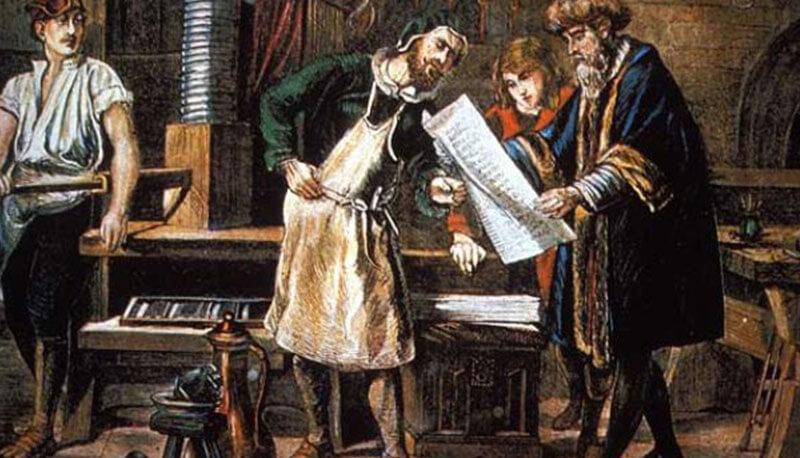
Around 1444 Johann Gutenberg it returned to Mainz, where in 1450 constituted a Societas with the banker Johann Fust, that contributed with 2000 Gulden, and the engraver Peter Schöffer (or Schäffer), to the purpose of to print the so-called one "Bible to 42 lines" on the base of the Vulgate. The work venne concluded February 23 1455 I press it "Hof zum Humbrecht" (today in Schustergasse, 18) and the book put in sale to Frankfurt. The edition provoked immediate enthusiasm for the typographical quality.
Immediately, after the publication the banker Fust asked for the return, with interest, of its contribution, causing a trial for insolvency against Gutenberg and the passage of the property of equipment and machinery to the same banker. Fust used them, together with Schöffer, to print in 1457 an edition of the Book of the Psalms. This presents new types in two heights and the printing bicroma of the capilettera.

Gutenberg's later years and legacy
In 1458 Johann Gutenberg it is associated to Konrad Humery, I criticize of Mainz, and public, done not sign, it "Bible to 36 lines" and other religious volumes of subject. In 1462 the bag of Mainz aside of Adolfo TWO of Nassau compels Gutenberg to leave the town. It will return in 1465, invited from the same Adolfo TWO that the appointment limb of the court, accordandogli you benefit and esentandolo from the taxes. In the same year the archbishop of Mainz guaranteed him a life annuity in recognition of its merits.
In 1468 Johann Gutenberg it dies leaving its precious material to Humery. Later on to the bag of Mainz the students of Gutenberg and of Schöffer disperse themselves for the Europe, contributing so to the spread of the new system of printing.
In 1998 an American jury of journalists elected Gutenberg "Man of the Millennium", more important person of the second millennium.
Domande da interrogazione
- Who was Johann Gutenberg and what is he known for?
- What significant partnership did Gutenberg form in 1450, and what was its purpose?
- What legal and financial challenges did Gutenberg face after publishing the 42-line Bible?
- How did Gutenberg's career progress after his initial financial setbacks?
- What was Gutenberg's legacy and recognition in the years following his death?
Johann Gutenberg was a German inventor, printer, and goldsmith, renowned for enhancing printing technology, particularly through the invention of movable type printing, which revolutionized the production of books.
In 1450, Gutenberg formed a partnership with banker Johann Fust and engraver Peter Schöffer to print the "42-line Bible," which was based on the Vulgate and marked a significant advancement in typographical quality.
After publishing the 42-line Bible, Gutenberg faced a lawsuit from Johann Fust, who demanded the return of his investment with interest, leading to Gutenberg losing his printing equipment and machinery to Fust.
Despite financial setbacks, Gutenberg continued his work by associating with Konrad Humery and publishing the "36-line Bible" and other religious texts. He later received recognition and a life annuity from the Archbishop of Mainz.
Gutenberg's legacy was the widespread dissemination of the printing press technology across Europe by his students. In 1998, he was posthumously honored as the "Man of the Millennium" by an American jury of journalists, highlighting his impact on the second millennium.



 Accedi a tutti gli appunti
 Tutor AI: studia meglio e in meno tempo


