


Concetti Chiave
- I versori [math] \hat{x} [/math] e [math] \hat{y} [/math] rappresentano le direzioni degli assi in un sistema di riferimento cartesiano.
- Il prodotto scalare tra i vettori [math] \vec{a} = 4 \hat{x} - 2 \hat{y} [/math] e [math] \vec{b} = 3 \hat{x} + \hat{y} [/math] viene calcolato sommando i prodotti delle rispettive componenti.
- Il prodotto scalare si semplifica grazie alla proprietà di ortogonalità dei versori, dove [math] \hat{x} \cdot \hat{y} = 0 [/math].
- Le componenti dei vettori sono: [math] a_x = 4 [/math], [math] b_x = 3 [/math], [math] a_y = -2 [/math] e [math] b_y = 1 [/math].
- Il risultato finale del prodotto scalare è 10, ottenuto da [math] \vec{a} \cdot \vec{b} = 4 \cdot 3 + (-2) \cdot 1 = 10 [/math].
[math] \hat{x}[/math]
e [math] \hat{y}[/math]
sono i versori lungo le direzioni degli assi [math]x[/math]
e [math]y[/math]
di un sistema di riferimento cartesiano.Sono dati i vettori
[math]\vec{a} = 4 \hat{x} - 2 \hat{y} [/math]
e [math]\vec{b} = 3 \hat{x} + \hat{y} [/math]
.- Calcola il prodotto scalare [math] \vec{a} \cdot \vec{b} [/math].
Svolgimento
Ricordiamo che i versori sono vettori che hanno lunghezza uguale a 1 e che, in un sistema di riferimento cartesiano nel piano, un vettore si esprime come[math]\vec{a} = a_x \hat{x} - a_y \hat{y} [/math]
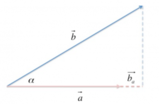
.Rappresentiamo i nostri vettori nel piano cartesiano:

Calcoliamo il prodotto scalare dei due vettori:
[math]\vec{a} = a_x \hat{x} - a_y \hat{y} , \vec{b} = b_x \hat{x} - b_y \hat{y}[/math]
[math] \vec{a} \cdot \vec{b} = (a_x \hat{x} - a_y \hat{y})(b_x \hat{x} - b_y \hat{y}) = [/math]
[math] a_x \cdot b_x \cdot \hat{x} \cdot \hat{x} + a_x \cdot b_y \cdot \hat{x} \cdot \hat{y} + a_y \cdot b_x \cdot \hat{x} \cdot \hat{y} + a_y \cdot b_y \cdot \hat{y} \cdot \hat{y} = [/math]
[math] a_x \cdot b_x \cdot \hat{x} ^2 \cdot + a_x b_y \hat{x} \hat{y} + a_y b_x \hat{x} \hat{y} + a_y \cdot b_y \cdot \hat{y} ^2 [/math]
I versori
[math] \hat{x} [/math]
e [math] \hat{y} [/math]
sono perpendicolari tra loro, quindi il loro prodotto scalare è nullo: [math] \hat{x} \cdot \hat{y} = 0[/math]
;
[math] = a_x b_x \hat{x} ^2 \cdot + a_x b_y \cdot 0 + a_y b_x \cdot 0 + a_y b_y \hat{y} ^2 = [/math]
[math] a_x b_x \hat{x} ^2 \cdot + a_y b_y \hat{y} ^2 [/math]
Il versore
[math] \hat{x} [/math]
è parallelo a se stesso, e lo stesso vale per il versore [math] \hat{y} [/math]
, quindi si ha che:
[math] \hat{x} \cdot \hat{x} = 1 \cdot 1 = 1 , \hat{y} \cdot \hat{y} = 1 \cdot 1 = 1[/math]
Quindi abbiamo:
[math] = a_x b_x \cdot 1 + a_y b_y \cdot 1 = a_x b_x + a_y b_y [/math]
Sapendo che
[math]a_x = 4 [/math]
, [math]b_x = 3 [/math]
, [math]a_y = -2 [/math]
, [math]b_y = 1 [/math]
, possiamo calcolare il prodotto scalare:
[math] \vec{a} \cdot \vec{b} = 4 \cdot 3 + (-2) \cdot 1 = 12 - 2 = 10 [/math]
Domande da interrogazione
- Come si calcola il prodotto scalare tra due vettori in un sistema di riferimento cartesiano?
- Qual è il risultato del prodotto scalare tra i vettori \(\vec{a} = 4 \hat{x} - 2 \hat{y}\) e \(\vec{b} = 3 \hat{x} + \hat{y}\)?
- Perché il prodotto scalare dei versori \(\hat{x}\) e \(\hat{y}\) è nullo?
Il prodotto scalare si calcola moltiplicando le componenti corrispondenti dei vettori e sommando i risultati. Per i vettori \(\vec{a}\) e \(\vec{b}\), si utilizza la formula \(\vec{a} \cdot \vec{b} = a_x b_x + a_y b_y\).
Il prodotto scalare \(\vec{a} \cdot \vec{b}\) è pari a 10, calcolato come \(4 \cdot 3 + (-2) \cdot 1 = 12 - 2\).
Il prodotto scalare dei versori \(\hat{x}\) e \(\hat{y}\) è nullo perché sono perpendicolari tra loro, quindi \(\hat{x} \cdot \hat{y} = 0\).




 Accedi a tutti gli appunti
 Tutor AI: studia meglio e in meno tempo


