


Concetti Chiave
- In the Middle Ages, England was the first among the British Isles to move towards a democratic government, starting with the nobles opposing King John's rule.
- The Magna Carta, signed by King John in 1215, was a pivotal document that limited the king's power and granted unprecedented rights to free Englishmen.
- The Magna Carta established principles that influenced future democratic societies, including the right to a trial by jury and the necessity of consent for taxation.
- The Great Council, initially opposing King John, evolved into the English Parliament, integrating representatives from towns and knights, marking a significant step in including freemen in governance.
- Simon de Montfort's leadership during King Henry III's imprisonment led to the first assembly known as Parliament, setting a precedent for modern democratic parliamentary systems.
The beginning of democracy in England
In the Middle Ages, before England, Scotland and Wales were united, England took the first step towards forming a democratic government.
As in many other countries, most of its people were serfs and there were very few freemen, whereas the wealthy and powerful class was made up of the nobles. The nobles did not like King John who ruled in the early years of the 13th century. One reason for this was the methods he used for taxation. Et that time England had a Great Council, formed by the chief nobles and Bishops of the whole country.
The Magna Carta and its effects
The nobles drew up a paper, stating the right of all free English men, and asked King John to sign it. This document limited the king’s power and granted rights to his subjects that they had never had before. King John declared that he would not to sign the paper. 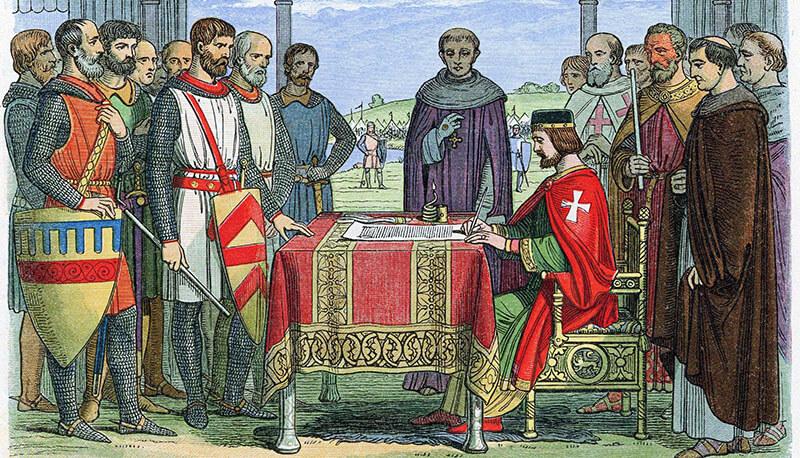 Most of his followers sided with the noblemen
It was in the 1215 that King John Lockland (he was so nicknamed because he had lost many land possession in France) angrily signed the “Great Charter”. Then he promised not to tax without the consent of the Great Council and agreed that justice would not denied or delayed to anyone. That’s why the Great Charter is considered a corner-stone of liberty in all democratic countries and American people –several countries later- took a hint from it in order to draw up the Bill Of Rights. There are still some articles resembling those of the time: for instance, an accused person has the right to a trial by jury.
The birth of the English Parliament
The Great Council that opposed King John grew into the first parliament, constituted by nobles and bishops . fifty years later, another king was ruling England. The nobles made war on him, too; they took him prisoner and locked him in the Tower of London. While the king was imprisoned, a leader of the nobles- Simon de Montfort - summoned a meeting of the Great Council. He also asked two citizens from each large town and two knights from each country. For the first time, freeman were represented in the government of England. The name of the Council was changed to Parliament.
Domande da interrogazione
- What was the significance of the Magna Carta in the development of democracy in England?
- How did the Great Council evolve into the English Parliament?
- How did the Magna Carta influence democratic principles in other countries?
The Magna Carta, signed by King John in 1215, was significant because it limited the king's power and granted unprecedented rights to free English men. It required the king to seek the Great Council's consent for taxation and ensured justice was not denied or delayed, laying the foundation for democratic principles.
The Great Council, initially composed of nobles and bishops, evolved into the English Parliament when Simon de Montfort summoned a meeting that included representatives from large towns and counties. This inclusion of freemen marked the first time they were represented in England's government, transforming the Council into Parliament.
The Magna Carta influenced democratic principles in other countries, notably inspiring the American Bill of Rights. Its articles, such as the right to a trial by jury, have been echoed in democratic documents worldwide, highlighting its role as a cornerstone of liberty.



 Accedi a tutti gli appunti
 Tutor AI: studia meglio e in meno tempo


