


Concetti Chiave
- The division of William I's kingdom led to a civil war known as "the Anarchy," which concluded with an agreement that Henry II, Matilda's son, would succeed after King Steven's death.
- Henry II's reign was marked by significant reforms, including the introduction of scutage and the establishment of Common Law, which aimed to ensure equal treatment under the law.
- The conflict between Henry II and the Church, notably with Thomas Becket, highlighted the tensions over ecclesiastical appointments, culminating in Becket's murder and Henry's subsequent penance.
- King John signed the Magna Carta in 1215 under pressure from rebellious barons, limiting his power and requiring consent for taxation, which laid the groundwork for democratic governance.
- The Magna Carta has evolved into a symbol of liberty, influencing modern democratic principles and documents like the United States Declaration of Independence and the Universal Declaration of Human Rights.
Indice
Division of the kingdom
When Williamm I died in 1087 his four children divided the Kingdom.
•
• Rufus nammed for his red hair, become the king with name of William II, he didn’t have children.
• Henry the youngest child became the king with the name of • Adela she was the only daughter, she had one son Steven. Matilda was the successor of Henry I but Steven, cousin of Matilda, would the throne Everybody supported Steven because the people wouldn’t have a woman on the throne. There was a civil war between the people who wanted Matilda to the throne and the people who wanted Matilda’s cousin, Steven, to the throne.
• The civil war ended with an agreement. Who said that after Steven’s death his successor would be Matilda’s son Henry II. This period of civil war Is called the anarchy.
Reforms of Henry II
Henry II was an important king who is remembered for some positive and some negative actions. Henry II was a warrior king and chivalric Hero, his Kingdom stretched from the Scottish border ti the south of France. He abolished the feudal system introducing the scutage. It was a tax that the barons and the knights paid not to go to war. With this money, the king paid the mercenaries, the professional soldiers who went to war in the place of the Norman nobles. Henry also reformed the justice, introducing the Common Law in addition to the existing ones: Canon Law e Roman Law. With te Common Law he sent the judges all over his kingdom to solve the problems among people. The decisions they took that based on old traditions, habits, unwritten rules became law everywhere in England. With this system, that is still used today, Henry wanted that all people were treated equally.
Conflict with the church
HENRY II AND THE CHURCH Henry also wanted to and check the power of the church, choosing the bishops and the archbishops. He had a close friend, Thomas Becket. Who was elected archbishop of Canterbury. This was and is the most important figure of the English church. At the time of Henry II, the archbishop of Canterbury represented the Pope in England.
Now, after the birth of the Anglican church, the archbishop of Canterbury is the leader of the English church. Henry asked Thomas to sign the Constitutions of Clarendon with which the archbishop passed all the powers in the hand of the king. Thomas refused and so the king sent him into exile. After five years, Thomas came back to Canterbury but on the 29th December 1170 he was killed in the Cathedral by some knights probably sent by the because the king said an unhappy sentence. At first the knights entered the cathedral and forced Becket out, but he calmly refused then the knights intervened with their swords leaving him four mortal wounds. It was a scandal first because Thomas was a man of church and then because he was killed in a holy place. Henry II was accused of his assassination but he defended himself, saying that he had certainly been angry with thomas but he didn’t want him dead but he only want to get rid of him. Thomas Becket was considered martyr and Henry II went London-Canterbury barefoot to be forgiven and he changed his royal clothes for itchy sackcloth. just 9 words and a lot of anger had nearly brought an end to the most powerful king in the world!
John Lackland
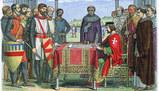
JOHN LACKLAND One of Henry Il’s sons was John. He was called Lackland because, during his reign, he lost a lot of lands that he had in France. Like a lot of other English nobles of the time, John had still some properties in Normandy (he and the other nobles were the descendants of the Normans who conquered England in 1066), but the French nobles claimed those properties for them. As a result, very often the English nobles had to send some soldiers to France in order to solve the situation. King John did the same, but he always lost. The problem was that he used the public money to pay the soldiers, putting a lot of taxes on his people. One day, the nobles, angry for the king’s behavior, forced him to sign the Magna Carta or Greath Charta. It was an important document because it stated that the monarch couldn’t put taxes without the nobles’ approval and that no free man could be put into prison without a fair trial. This was a step towards democracy.
Magna Carta and democracy
When John died, his son, Henry III, was only nine so the nobles governed all together till his majority. This group of barons was called council. When Henry III grew up, he still asked for advice to the council that became a point of reference for him and the following kings. In 1265 this council became Parliament from the French word “parler” because it was the place where the people discussed about the problems of the nation. This first Parliament was made up of the barons, two members of the clergy and two knights. In 1295 Model Parliament started. It was made up of barons, members of the clergy, two knights and two citizens. The presence of the citizens was important because they represented the middle classes that gave great impulse to the economy of the time. England was the first nation to have a Parliament, showing of being a democratic country.
Origins of the Magna Carta
This may look like a plain, unassuming piece of parchment, but it’s actually one of the most famous documents in the world. Magna carta meaning ‘’the great charter’’ has inspired people across the centuries, from thomas jefferson to mahatma gandhi. But why was the charter originally created? What does it actually say? In 1215, the ruler was king john. Many people believe that king john was one of the worst kings in the story. He imprisoned his former wife; he starved his opponents to death; he allegedly murdered his own nephew, and pulled the beads of the irish criefs. King John had imposed heavy taxes on his barons in order to pay for his expensive foreign wars. If they refused to pay he punished them severely or seized their property. The barons demanded that king john obey the law; when he refused they captured london and the king was forced to negotiate. The two sides met at runnymede in june 1215 the result of the negotiations was written by the king’s clerks in the documents we know as magna carta. Although most of the charter’s clauses dealt with medieval rights and customs, magna carta has become a powerful symbol of liberty around the world. The most famous clause which is still part of the law today, for the first time gave all ‘free men’ the right to justice and a fair trial. ‘No man shall be or imprisoned by the judgement of their equals and by the law of the land. To no one will we sell, to no one deny or delay right or justice. However, this clause was not as liberal at it sounds, the charter only applied to ‘free men’ The vast majority of people in 1215 were unfree peasants who were ruled over by their landowners. And although magna carta was intended to create peace between king john and his rebellious barons, england was plunged into civil war after the pope declared the charter invalid. When king john died of dysentery in 1216 nine year old Henry 3 took to the throne. To keep the peace magna carta was reissued several times during the 13th century, until It was finally made part of English law. Magna carta has lived on for 800 years, and is echoed in the united states declaration on independence and the universal declaration of human rights. Perhaps magna carta’s most important legacy is that everyone (including our leaders) must obey the law.
English feudal society
What started out as a document of specific complaints from a group of barons has turned into a international symbol of liberty, without which we might not have the rights we value so much today THE STORY OF MAGNA CHARTA It’ the 15th of june 1215 john of england is been cornered by all of his knights that are angry because they are fed up with king john’s unfair. Around 1200, england society was organised under the feudal system, at the bottom were the peasants they farmed land that they had rented from the barons. The baron’s were wealthy because they’ve done a favour for the king who’d given them land as a reward. At the top was the king, he owned everything in the kingdom and could do all as he likes (including making people pay tax). The king’s power was based on the belief supported by the pope and the archbishop of canterbury. The king’s power also depended on the size of his empire. Who understood this was Henry Plantagenet who decided to make a huge empire. He inherited some lands in France but wanted more. The province of Aquitaine in the southwest of France belonged to Eleanor, when Henry married her, her rule grew by leaps and bounds, and then when he became king of England his empire expanded. Henry and Eleanor had eight children: William, Henry, Matilda, Richard, Geoffrey, Eleanor, Joan, and John. John as the youngest son was unlikely to ever be king, but fate has a way of changing everything. William, Henry, Goffrey and when Henry II died Richard became king of England. Richard spent barely any time in England he was off fighting the crusades or battling rebels in France. Richard spent barely any time in England. He was off fighting the Crusades or battling the rebels in France. In 1199, while trying to take a castle in Shadow, Richard was wounded and died. So, despite the odds, John was crowned king of England. Not only John inherited a really big crown, he also inherited a lot of worries:
1) He needed to expand and protect his father’s empire;
2) King Philip II was a huge threat to John’s empire in France, plus he wanted to invade England and install his son Louis as king;
3) Pope Innocent III wanted to appoint Stephen Langton as archbishop of Canterbury, but king John wanted to appoint his own archbishops, so the pope forbade everyone in England from holding religious ceremonies for five years. The argument ended when John got scared that Philip was planning an invasion: John needed pope’s help to stop Philips’ invasion, so he paid a massive tribute and was forgiven, then Stephen Langton became archbishop of Canterbury.
4) Finally, John had to worry about the barons: he needed their support, but the barons were fed up. In 15 years, king John had lost almost all of his dad’s lands in France and it rerated his barons very badly. In July 1214 he decided to attack Bovines, but lost. On April 1215 (a year later) the rebel barons tried to meet king John renouncing their allegiance (obedience), even capturing London, but again and again John ignored them; the rebel nobles even considered asking prince Louis (son of Philip II of France) to became king: this got king John’s attention.
Conflicts of John
In June 1215 rebel barons arranged to meet him in neutral territory. King John had no choice: he accepted the barons’ demands and put his royal seals on the act called “Charter of liberties”. He pretended to guard on it secretly and then hoped to do something, then waited in Dover for responses. Meanwhile scrams made copies of the charter and sent them across the river. Rebel basons also took possession of some of John’s castles, including Rochester castle. In September a letter arrived from the pope which said that God rejected and condemned that settlement, so the charter must be considered null and void of all validity forever. But this did absolutely nothing to change the rebel balance, so John started a rampage across England: firstly, he destroyed Rochester bridge, then attacked the castle. Meanwhile Louis arrived in London; the barons swore obedience to him. In October John felt forced to leave England but since he hasted, he went across the way and his baggy train got stuck in quicksand, so he lost all his treasures. He tried desperately to hold on to the crown but he somehow lost it into the sea. Then king John got sick and died. Then his son Henry became king: he had to be crowned with a plain gold ring. English barons proffered a boy young over the French prince, especially since they would be in a position to advice. Anyway, the country still was a mess, so William Marshall, Henry III’s main advisor, reissued the charter of liberties as a royal charter to sure rebel barons that the new king would keep it works. In this way he made the civil war end.
Legacy of the Magna Carta
When the charter was reissued in 1217 it had a second part: since it was on a bigger sheet, it became “the Great Charter”, or Magna Charta. In 1225 Henry III needed to raise taxes which raised a few eyebrows, so to prevent another rebellion, he reissued Magna Charta again. In 1297 his son, Edward I had the same problem: he had more money to fight over Scotland and Wales, and adopted the same solution. Magna Charta entered into the statute rolls as English law, which meant that if a king wanted to change it, he had to get the approval by parliament. In England Magna Charta was the first step towards building a fair society where everyone has equal rights and nobody has more powers than others. It becomes a model for other countries, including the USA, Australia, New Zeland, Canada and India, and more…). After the second world war, the United Nations decided to do something to protect the rights of the planet. Eleanor Roosevelt and her team wrote the Universal Declaration of human rights; she described it as a Magna Charta for all mankind.
Domande da interrogazione
- What was the significance of the division of the kingdom after William I's death?
- How did Henry II's reforms impact the English legal system?
- What was the nature of the conflict between Henry II and the church?
- Why was King John forced to sign the Magna Carta, and what were its implications?
- How has the Magna Carta influenced modern democratic principles?
The division of the kingdom after William I's death in 1087 led to a civil war known as "the Anarchy," as his children, including William II and Henry, vied for power. This conflict ended with an agreement that Matilda's son, Henry II, would succeed after Steven's death, highlighting the complexities of succession and governance during that period.
Henry II introduced significant reforms, including the abolition of the feudal system and the introduction of scutage, a tax for military exemption. He also established the Common Law, sending judges across the kingdom to ensure equal treatment under the law, a system that remains influential today.
Henry II's conflict with the church centered around his attempt to control ecclesiastical power by appointing bishops and archbishops. This led to a fallout with Thomas Becket, the Archbishop of Canterbury, culminating in Becket's murder, which scandalized the nation and forced Henry to seek penance.
King John was compelled to sign the Magna Carta in 1215 due to his oppressive taxation and misuse of power, which angered the barons. The Magna Carta limited the king's authority, requiring noble consent for taxation and ensuring fair trials, marking a pivotal step towards democracy.
The Magna Carta has become a symbol of liberty and justice, influencing documents like the United States Declaration of Independence and the Universal Declaration of Human Rights. Its legacy lies in establishing the principle that everyone, including leaders, must obey the law, laying the groundwork for modern democratic societies.



 Accedi a tutti gli appunti
 Tutor AI: studia meglio e in meno tempo


