


Concetti Chiave
- Jonathan Swift, a prominent English writer and satirist, spent his early years in Ireland and England, engaging in political circles and religious duties.
- Swift's "Gulliver's Travels" is a renowned satirical work critiquing human nature and society through the adventures of Lemuel Gulliver.
- In "Gulliver's Travels," each of Gulliver's voyages offers a satirical take on different aspects of humanity, including politics, philosophy, and the human condition.
- Gulliver's encounters with the Houyhnhnms, rational horses, highlight themes of reason versus the brutish nature of humans, represented by the Yahoos.
- The narrative of Gulliver serves as a vehicle for Swift's commentary on European society's decline into corruption and loss of civilization.
Indice
Swift's early life and career
Swift is considered the greatest English writer of his time and one of the largest satirist ever existed.
He was son of an English family settled in Ireland and during his childhood he studied in Kilkenny (Kilkenny School) and then in Dublin (Trinity College). After going to England on his mother's advice, he meets, in the house of Sir William Temple, Esther Johnson (Stella), to which he will be forever connected. After having taken religious orders he becomes parish priest of Kilroot, but living mostly in London where he participates to the most important political circles. He becomes councilman of the Tory government supporting it with pamphlets and articles.
With the fall of the government Swift returns in Ireland having obtained the role of dean of the Church of St. Patrick in Dublin. In this period of stay in the island exposes the oppressions to which the Irish people (even if he despises them) are subject by English and local government. 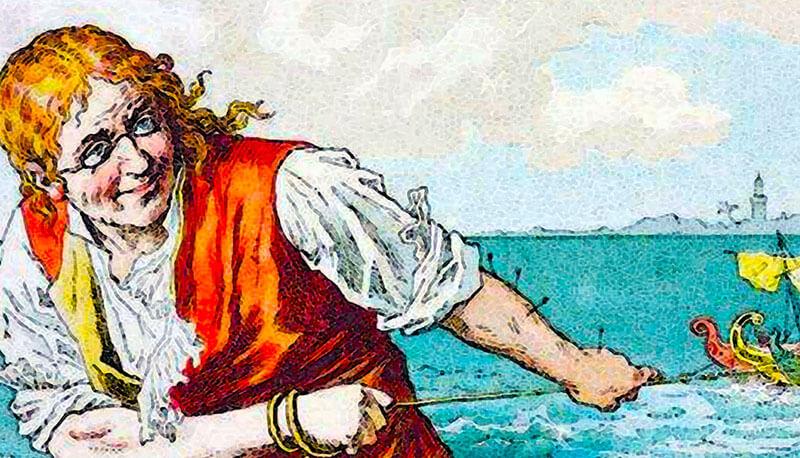 After the death of beloved his mental disturb worsens more and more until his death.
Gulliver's travels and satire
Gulliver's Travel is his most famous book. Written as an adventure novel it is actually a cruel satire of human race, civilisation and Anglo-Irish (his fellow countrymen are the wild Yahoo). Lemuel Gulliver, doctor on a merchant ship, is shipwrecked on the island of Lilliput, where everything, beginning by the inhabitants, is large a fifteenth of persons and objects we know. In the second part instead Gulliver visits Brobdingnag, where the ratio is turned upside down and where the doctor becomes the of the King's daughter, who keeps him between her playthings. In the third part Gulliver visits Laputa and the continent that has Lagado as capital, where the satire is addressed against philosophers, historians and inventors. In the island of Glubdubdrib, then, Gulliver evokes the shadows of the great man of the antiquity and from their answers he discovers their bad habits and meanness; while among the immortal Struldbrug, he notices that the largest sadness for the man would be the perspective of not giving an end to the tedium vitae. In the fourth part then, the virtuous easiness of the Houyhnhnm horses contrasts with the nauseous brutality of the Yahoo, beasts with a human aspect.
Gulliver's adventures and discoveries
Gulliver sails from Bristol on May 4, 1699, after 6 months he is shipwrecked somewhere on the island of Lilliput where he falls asleep. The Lilliputians, the very small inhabitants of the island, take his body and put it In a temple. Gulliver learns many things about this people, their language and their customs. After many adventures he returns to England.
Gulliver sails again for India but finds the land of Alaska. He meets the inhabitants, they are giants. Gulliver’s size causes him many problems.
After many adventures Gulliver sails another time to return home but he is attacked by pirates who set him on a small boat. He arrives to Laputa’s island whose inhabitants are absent-minded astronomers and philosophers. Gulliver visits their capital, Lagado and its academy where absurd experiments are carried out.

Gulliver's encounters with the Houyhnhnms
Gulliver goes to an island inhabited by horses endowed with reason, the Houyhnhnms, who are served by a race of filthy creatures very similar to human beings, the Yahoos. Gulliver admires the superiority of the Huoyhnhnms. The horses banish him and he builds a canoe to go back home.
The travel is a positive experience that gives the traveller and the reader something important that can help them in their life. The message that Swift wants to communicate is that Europe is losing its civilization and falling into corruption and other bad things. In every book there is a hidden theme: in the first for example he speaks about man’s pettiness and greed, in the second about his pride, in the third about representation of pure reason and in the last book about the absurdities and evil of the various professions.
Gulliver tells his experiences in first person in a prose style, he is not Swift in person but he is an invented character, an instrument.
Domande da interrogazione
- What is Jonathan Swift's significance in English literature?
- How did Swift's early life and career shape his literary work?
- What is the central theme of "Gulliver's Travels"?
- How does Swift use the character of Lemuel Gulliver in his satire?
- What message does Swift convey through Gulliver's encounters with the Houyhnhnms and Yahoos?
Jonathan Swift is regarded as the greatest English writer of his time and one of the largest satirists ever, known for his sharp critiques of human nature and society.
Swift's upbringing in Ireland and his involvement in political circles in London influenced his satirical writing, as seen in his critiques of English and Irish governance and society.
"Gulliver's Travels" is a satirical adventure novel that critiques human nature, civilization, and the absurdities of various professions, using the character Lemuel Gulliver's encounters with different societies.
Lemuel Gulliver serves as an instrument for Swift's satire, narrating his experiences in a first-person prose style to highlight themes of human pettiness, pride, and the corruption of civilization.
Through Gulliver's admiration for the rational Houyhnhnms and disdain for the brutish Yahoos, Swift communicates a critique of European civilization's decline into corruption and moral decay.





 Accedi a tutti gli appunti
 Tutor AI: studia meglio e in meno tempo


