


Concetti Chiave
- Daniel Defoe, born in London to a merchant family, was educated among Dissenters and later pursued journalism with a focus on politics.
- "Robison Crusoe" is based on the true story of Alexander Selkirk and is considered the first modern novel, depicting a man's survival on a deserted island.
- Crusoe's life on the island is chronicled in a journal style, highlighting his encounters with the native Friday and eventual return to England.
- Crusoe's survival is attributed to his hard work and creativity; he adopts roles such as hunter and builder, and even attempts to colonize and educate Friday.
- Driven by economic and political aspirations, Crusoe leaves England to improve his wealth through the slave trade, reflecting middle-class ambitions.
Indice
Daniel Defoe's early life
Daniel Defoe was born in London. Son of a merchant, he was educated at a school of Dissenters (puritans). He travelled for some years in Europe. Around 1700 Defoe turned to journalism and became particularly interested in politics, writing pamphlets and essays. He wrote in prose, and he published a novel called "Robison Crusoe". He died in 1713 in London.
Robison Crusoe tells of a man's shipwreck on a desert island. The plot is based on the true story of the Scottish seaman Alexander Selkirk. It is generally regarded as the first modern novel.
What was Crusoe's life on the island like?
Robison Crusoe is a young man living in England who dreams of going to sea. Crusoe is presented with a new proposition: to being a business in the slave trade. While he is travelling to Africa there is a terrible storm, he is shipwrecked and he is the only survivor. 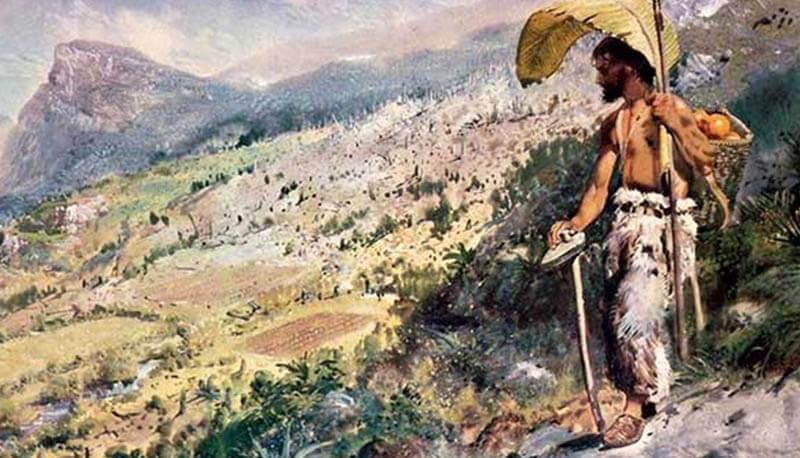 He remains in that island for 28 years. In second part the novel centres around his life on the island and it is written in the form or a journal. He meets the native Friday. In the last part Crusoe and Friday are taken to England and he discovers that he has become rich. He marries, but when his wife dies, he decides to go back to sea.
Crusoe's survival skills
Robison Crusoe is a legendary figure; thanks to his hard work, determination and creative skills, he manages to organize his daily life perfectly. He becomes a hunter, a builder and a shepherd. He battles to survive and wins that battle.
Robison behaves as a colonist even with the native he meets, Friday. He gives a name to the slave, teaches him his language and new techniques and tries to convince him to embrace his religion.
Crusoe's economic motivations
Born into ten England middle class, he expressed the economic and political aspirations of his class. Although Robison has a modest and secure life in England, he leaves in order to improve his financial situation and seek adventure. It is more profitable to trade with the indigenous people of non-western countries because they value goods differently from the Europeans. He turns to the profitable business of the slave trade. Shipwreck on the deserted island he does not lose heart. He recreates the kind of micro-social structure which is as close as possible to the one he left.
Domande da interrogazione
- What inspired Daniel Defoe to write "Robinson Crusoe"?
- What role did economic motivations play in Robinson Crusoe's adventures?
Daniel Defoe's novel "Robinson Crusoe" was inspired by the true story of the Scottish seaman Alexander Selkirk, who was shipwrecked on a desert island. The novel is considered the first modern novel and reflects Defoe's interest in politics and prose writing.
Economic motivations were central to Robinson Crusoe's adventures. Born into the middle class, Crusoe sought to improve his financial situation by engaging in the slave trade and trading with indigenous people. His desire for economic gain drove him to leave his secure life in England for adventure and profit.




 Accedi a tutti gli appunti
 Tutor AI: studia meglio e in meno tempo


