


Concetti Chiave
- Daniel Defoe was born in London in September 1660; his original surname was Foe, later changed to Defoe for stylistic reasons.
- Defoe's education at Newton Green Academy was followed by a career in trade, leading to travels across Europe.
- Facing bankruptcy, Defoe turned to writing, producing treatises on various subjects, which led to his imprisonment for expressing controversial opinions.
- He worked as a secret agent for the Tory government and launched his journal "The Review" under the condition of not criticizing the government.
- Defoe's most famous novel, "Robinson Crusoe," was published in 1719, detailing the adventures of a shipwrecked man surviving on a deserted island.
Daniel's early life
Daniel Defoe is probably born in September 1660 in London. His parents are Puritans and didn't accept the authority of the Church so they didn't register his son's birth. His original name was Daniel Foe, but later he change it in Daniel Defoe because, in his opinion it was more fashionable. He attended Newton Green Academy where he got a solid education and, after that, he went into trade and travelled in Europe.
Career and challenges
Back in England he got married but he also went to bankrupt so he turned to writing to earn money. Defoe wrote many treatises on commercial, economical and political subjects and as a result of some of the opinions that he expressed, he was arrested and had to spend time in prison. Then, the leader of the Tory party offered him a job as a secret agent for the government and also helped him to set up his own journal "The Review" on the condition that, in his writing he wouldn't attack the government.
In the last years of his life he turned to write novel, in fact, was in 1719 that he wrote his most known work: the novel "Robinson Crusoe".
He died in 1731.
Robinson Crusoe's adventures
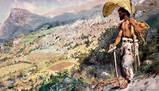
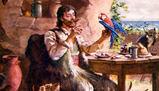
Robinson Crusoe, born in York, decides to go to sea despite his father's opposition. For several years he has an adventurous life: he is taken prisoner by Moor in Africa, he becomes a planter in Brazil and also a slave trader. During one of his sea trips he is shipwrecked on a desert island in the South America and he is the only survivor. Little by little he manages to build himself a house and he learns how to cultivate and go hunting. From the wreck he saved paper, pen and ink, with which he keeps a diary of his life on the island, and a Bible, that he reads every day.
During a trip exploration on the side of the island opposite the one in which he lives, Robinson mets a group of cannibal who are going to kill another Indian and using his gun , he saves the prisoner. Then he gives him the name Friday, because it was in Friday that he was saved, and tried to civilize him.
After twenty-eight years on the island an English ship save Robinson and takes him home.
Domande da interrogazione
- What were some significant challenges Daniel Defoe faced in his career, and how did he overcome them?
- How did Daniel Defoe's early life and education influence his career?
- What are some key events in Robinson Crusoe's adventures, and how do they reflect his character development?
Daniel Defoe faced financial difficulties, leading to bankruptcy, and was imprisoned due to his controversial writings. He overcame these challenges by turning to writing as a source of income and later working as a secret agent for the government, which also helped him establish his journal, "The Review."
Daniel Defoe received a solid education at Newton Green Academy, which laid the foundation for his diverse career in trade, writing, and eventually espionage. His Puritan upbringing and the lack of a formal birth record due to his parents' beliefs may have influenced his independent and adventurous spirit.
Key events in Robinson Crusoe's adventures include being shipwrecked on a desert island, building a home, learning to hunt and cultivate, and saving a prisoner named Friday from cannibals. These events reflect his resilience, resourcefulness, and evolving sense of companionship and civilization.




 Accedi a tutti gli appunti
 Tutor AI: studia meglio e in meno tempo


