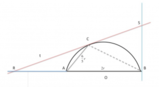
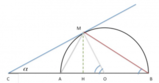
Sono date la circonferenza γ di centro
[math]O[/math]
e diametro
[math]AB = 2[/math]
e la corda
[math]AC = frac(6)(\sqrt{13})[/math]
. Condotta per
[math]C[/math]
la retta tangente a γ che incontri in
[math]D[/math]
il prolungamento di
[math]AB[/math]
, determinare:
- Le misure dei lati e le funzioni goniometriche degli angoli dei triangoli
[math]ACB[/math]
, [math]OCD[/math]
e [math]BCD[/math]
;
- Le funzioni goniometriche degli angoli
[math]hat{CAE}[/math]
e [math]hat{CBE}[/math]
, essendo [math]E[/math]
il simmetrico di [math]C[/math]
rispetto ad [math]AB[/math]
.

Svolgimento (1)
Cominciamo prendendo in considerazione il primo triangolo,
[math]ACB[/math]
: esso è rettangolo, poiché inscritto in una semicirconferenza.
Conoscendo la misura di due dei suoi lati, possiamo determinare il terzo con il teorema di Pitagora:
[math]CB = \sqrt{AB^2 - AC^2} = \sqrt(2^2 - (frac(6)(\sqrt(13)))^2) = \sqrt(4 - frac(36)(13)) = [/math]
[math] \sqrt{frac(16)(13)} = frac(4)(\sqrt(13))[/math]
ora, ricaviamo le funzioni goniometriche degli angoli mediante il primo teorema sui triangoli rettangoli:
[math]AC = AB \cdot \\sin (hat{ABC}) = AB \cdot \\cos(hat{CAB}) [/math]
[math] \\sin (hat{ABC}) = \\cos(hat{CAB}) = frac(AC)(AB) = frac(frac(6)(\sqrt{13}))(2) = [/math]
[math] frac(6)(\sqrt{13}) \cdot 1/2 = frac(3)(\sqrt{13}) [/math]
[math]CB = AB \cdot \\cos(hat{ABC}) = AB \cdot \\sin (hat{CAB}) [/math]
[math] \\cos(hat{ABC}) = \\sin (hat{CAB}) = frac(CB)(AB) = frac(frac(4)(\sqrt{13}))(2) = [/math]
[math] frac(4)(\sqrt{13}) \cdot 1/2 = frac(2)(\sqrt{13}) [/math]
Per quanto riguarda l'angolo
[math] hat{ACB} [/math]
, sappiamo che esso è rettangolo, di conseguenza conosciamo già le sue funzioni goniometriche:
[math] \\sin (hat{ACB}) = 1 , \\cos(hat{ACB}) = 0 [/math]
Passiamo ora al secondo triangolo,
[math]OCD[/math]
.
Sappiamo già che
[math]OC = 1[/math]
, poiché corrisponde al raggio della circonferenza.
Inoltre, sappiamo che
[math]hat{COD} = 2 hat{CAB}[/math]
, poiché un angolo al centro e uno alla circonferenza che insistono sullo stesso arco sono uno il doppio dell'altro.
Cominciamo quindi trovando le funzioni goniometriche di questo angolo:
[math] \\sin (hat{COD}) = \\sin(2 hat{CAB})[/math]
Applichiamo le formule di duplicazione:
[math] \\sin (hat{COD}) = \\sin(2 hat{CAB}) = 2 \\sin (hat{CAB}) \\cos(hat{CAB}) = [/math]
[math]2 \cdot frac(2)(\sqrt{13}) \cdot frac(3)(\sqrt{13}) = frac(12){13} [/math]
Troviamo ora il suo coseno tramite la relazione fondamentale:
[math]\\cos(hat{COD}) = \sqrt{1 - \\sin ^2 (hat{COD})} = \sqrt(1 - (frac(12)(13))^2) = [/math]
[math] \sqrt{1 - frac(144)(169)} = \sqrt(frac(169 - 144)(169)) = \sqrt(frac(25)(169)) = frac(5)(13)[/math]
Il triangolo in questione è rettangolo, poiché il raggio forma con la tangente un angolo di
[math]90°[/math]
. Quindi, possiamo trovare il lato
[math]OD[/math]
mediante il primo teorema sui triangoli rettangoli:
[math]OD = frac(OC)(\\cos(hat{COB})) = frac(1)(5/(13)) = (13)/5 [/math]
Con il teorema di Pitagora ricaviamo l'altro cateto:
[math]CD = \sqrt{OD^2 - OC^2} = \sqrt(((13)/5)^2 - 1) = \sqrt(frac(169)(25) - 1) = [/math]
[math]\sqrt{frac(169 - 25)(25)} = \sqrt(frac(144)(25)) = (12)/5 [/math]
Sempre mediante il primo teorema sui triangoli rettangoli ricaviamo
[math]\\cos(hat{CDO})[/math]
:
[math]\\cos(hat{CDO}) = frac(CD)(OD) = frac((12)/5)((13)/5) = (12)/5 \cdot 5/(13) = frac(12)(13) [/math]
[math]\\sin (hat{CDO}) = \sqrt{1 - \\cos^2 (hat{CDO})} = \sqrt(1 - (frac(12)(13))^2) = [/math]
[math] \sqrt{1 - frac(144)(169)} = \sqrt(frac(169 - 144)(169)) = \sqrt(frac(25)(169)) = frac(5)(13)[/math]
Il restante angolo,
[math]hat{ACB}[/math]
, è rettangolo, di conseguenza conosciamo già le sue funzioni goniometriche:
[math] \\sin (hat{ACB}) = 1 , \\cos(hat{ACB}) = 0 [/math]
Consideriamo il triangolo
[math]BCD[/math]
;
abbiamo già trovato in precedenza le funzioni goniometriche dell'angolo
[math]hat{BDC}[/math]
:
[math] \\cos(hat{BDC}) = frac(12)(13) , \\sin (hat{BDC}) = frac(5)(13) [/math]
Inoltre, abbiamo la lunghezza del lato
[math]CD[/math]
e del lato
[math]CB[/math]
:
[math]CD = frac(12)(5) , CB = frac(4)(\sqrt{13}) [/math]
Ricaviamo la lunghezza di
[math]BD[/math]
per differenza:
[math]BD = OD - OB = frac(13)(5) - 1 = 8/5 [/math]
Per trovare le funzioni goniometriche dei suoi angoli, applichiamo il teorema dei seni:
[math] frac(CB)(\\sin (hat{CDB})) = frac(CD)(\\sin (hat{CBD})) [/math]
[math] \\sin (hat{CBD}) = frac(CD \cdot \\sin (hat{CDB}))(CB) = frac(frac(12)(5) \cdot frac(5)(13))(frac(4)(\sqrt{13})) = [/math]
[math] frac(12)(13) \cdot frac(\sqrt{13})(4) = frac(3\sqrt{13}){13} [/math]
[math]\\cos(hat{CBD}) = \sqrt{1 - \\sin ^2 (hat{CBD})} = \sqrt(1 - (frac(3\sqrt(13))(13))^2) = [/math]
[math] \sqrt{1 - frac(117)(169)} = \sqrt(frac(169 - 117)(169)) = \sqrt(frac(52)(169)) = \sqrt(frac(4)(13)) = frac(2)(\sqrt(13)) [/math]
Poiché però questo angolo è ottuso, il suo coseno è negativo:
[math] \\cos(hat{CBD}) = - frac(2)(\sqrt{13}) [/math]
Applichiamo di nuovo il teorema dei seni per trovare le funzioni goniometriche dell'ultimo angolo:
[math] frac(BD)(\\sin (hat{BCD})) = frac(CD)(\\sin (hat{CBD})) [/math]
[math] \\sin (hat{BCD}) = frac(BD \cdot \\sin (hat{CBD}))(CD) = frac(frac(8)(5) \cdot frac(3\sqrt{13}){13})(frac(12)(5)) = [/math]
[math] frac(24 \sqrt{13})(65) \cdot frac(5)(12) = frac(2\sqrt{13}){13} [/math]
[math]\\cos(hat{BCD}) = \sqrt{1 - \\sin ^2 (hat{BCD})} = \sqrt(1 - (frac(2\sqrt(13))(13))^2) = [/math]
[math] \sqrt{1 - frac(52)(169)} = \sqrt(frac(169 - 52)(169)) = \sqrt(frac(117)(169)) = \sqrt(frac(9)(13)) = frac(3)(\sqrt(13)) [/math]
Svolgimento (2)

Determiniamo le funzioni goniometriche dell'angolo
[math]hat{CAE}[/math]
, sapendo che esso è il doppio dell'angolo
[math]hat{CAB}[/math]
:
[math] hat{CAE} = 2 hat{CAB}[/math]
[math] \\cos(hat{CAE}) = \\cos( 2 hat{CAB}) = 2 \\cos^2(hat{CAB}) - 1 = [/math]
[math] 2 \cdot frac(9)(13) - 1 = frac(18)(13) - 1 = frac(5)(13) [/math]
[math] \\sin (hat{CAE}) = \sqrt{1 - \\cos^2 (hat{CAE})} = \sqrt(1 - (frac(5)(13))^2) = [/math]
[math] \sqrt{1 - frac(25)(169)} = \sqrt(frac(169 - 25)(169)) = \sqrt(frac(144)(169)) = frac(12)(13) [/math]
Applichiamo lo stesso procedimento per l'angolo
[math]hat{CBE}[/math]
:
[math] hat{CBE} = 2 hat{CBA}[/math]
[math] \\cos(hat{CBE}) = \\cos( 2 hat{CBA}) = 2 \\cos^2(hat{CBA}) - 1 = [/math]
[math] 2 \cdot frac(4)(13) - 1 = frac(8)(13) - 1 = - frac(5)(13) [/math]
[math] \\sin (hat{CBE}) = \sqrt{1 - \\cos^2 (hat{CBE})} = \sqrt(1 - ( - frac(5)(13))^2) = [/math]
[math] \sqrt{1 - frac(25)(169)} = \sqrt(frac(169 - 25)(169)) = \sqrt(frac(144)(169)) = frac(12)(13) [/math]






 Accedi a tutti gli appunti
 Tutor AI: studia meglio e in meno tempo


