


Concetti Chiave
- Vladimir and Estragon are two vagabonds waiting for someone named Godot on an empty plateau.
- The existence and identity of Godot are uncertain, providing a central theme of ambiguity.
- A boy appears at the end of each act, promising Godot's arrival the next day.
- Pozzo and his victim Lucky join Vladimir and Estragon, introducing a dynamic of power and submission.
- Lucky's speech consists of a stream of words lacking meaningful context, contrasting with the inactivity of the others.
Waiting for Godot
Vladimir and Estragon, two vagabonds, are straned on a dark, dreary, empty plateau and wait for somebody called Godot, about whom little is known, either who he is, or whether he actually exists at all. At the end of each of the two acts a small boy shows up who assures the hoboes that Godot will definetly show up tomorrow. Two more people suddenly show up on the scene: Pozzo, a very brutal fellow, leading his victim Lucky on a leash as they amble onto the stage to join the waiting hoboes. On Pozzo's orders, Lucky must "think" - and he utters a slew of words without meaningful context. Vladimir and Estragon don't join in this strange game the pair practise, but remain passively waiting, innocently inactive.
The Life of Beckett
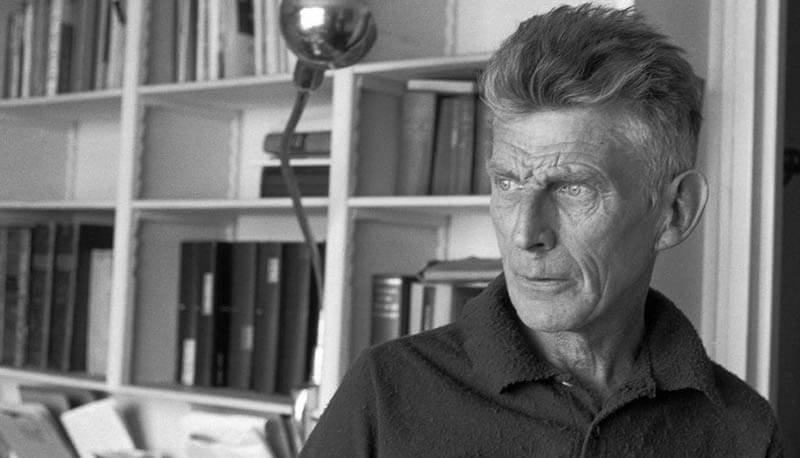
Beckett lived in France from 1937 until his death. This most "apolitical" of writers joined the
Domande da interrogazione
- What is the central theme of "Waiting for Godot"?
- Who are the main characters introduced in "Waiting for Godot," and what is their situation?
- How does the character of Lucky contribute to the play's themes?
The central theme of "Waiting for Godot" is the existential nature of human life, depicted through the characters Vladimir and Estragon, who wait endlessly and passively for someone named Godot, whose existence is uncertain.
The main characters are Vladimir and Estragon, two vagabonds stranded on a desolate plateau, waiting for Godot. They encounter Pozzo, a brutal man, and his victim Lucky, who is forced to "think" on command.
Lucky contributes to the play's themes by showcasing the absurdity and lack of meaning in life. His incoherent speech, prompted by Pozzo, reflects the chaotic and nonsensical nature of existence, aligning with the play's existential undertones.



 Accedi a tutti gli appunti
 Tutor AI: studia meglio e in meno tempo


