


Concetti Chiave
- Richard the Lionheart, known for his involvement in the 3rd Crusade, reigned from 1189 to 1199, mostly living abroad.
- During Richard's absence, his brother John, dubbed "Lackland," acted as king and later succeeded him but was unsuccessful in his campaigns against France.
- In 1215, King John's attempts to finance a war through heavy taxes led to the nobles, clergy, and middle classes forcing him to sign the Magna Charta.
- The Magna Charta limited the king's power by ensuring no imprisonment without a fair trial and requiring assembly consent for new taxes.
- Despite its focus on the interests of the upper classes, the Magna Charta is seen as a foundational step towards British democracy.
Indice
Richard the Lionheart's reign
At Henry 2nd's death in 1189 Richard I named/called “the Lion Heart” succeeded to the throne and he reigned from 1189 to 1199 but he always lived abroad.Actually he was called the Lion Heart because throughout his life he was engaged in fighting in the Holy Land in the 3rd Crusade.
During his absence his younger brother John acted as king and indeed at Richard’s death he succeeded to the throne. He was named “Lackland” because He was unsuccessful in all of his wars against France and he had even lost Normandy.
Magna Charta and its impact
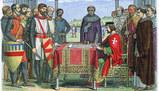
One of the reason why he was unpopular lies also in the fact that in 1215 he tried to reconquer Normandy so he asked the support of the nobles and the clergy as well as of the rising middle classes. In particular what he did was to impose heavy taxes to finance the war against France. Since They refused to finance him they (nobles, church and middle classes) forced him to sign an agreement, an important document called Magna Charta (or The Great Charter) at Runnymede, a place outside London.
Principles of Magna Charta
According to this document they meant to limit the power of the king and actually this document greatly limits his power because it stated/ asserted that:
1) No one could be imprisoned or submitted to judgement except by a court of peers. This implied that the king didn't have the power to send to prison anyone. No one could be send to prison without a fair trial/legal process.
2) The king could exercise the right to leave new taxes only with the consent of an assembly. He was no longer allowed to impose/establish new taxes without the consent of an assembly. This assembly didn't include the representatives of any strata of the population (for example the lower strata) but the social classes represented in this assembly/ the members were the barons, the Church and later on even the new rising/emerging classes of the merchants which started being represented inside/within this assembly very soon.
Legacy of Magna Charta
It’s generally considered and it will always be considered as an important step towards democracy and the most important foundation on which British democracy is founded because it asserted, affirmed, stated essentially 2 fundamental principles on which future democracy will be based from now on.
Although Magna Charta was not drawn/designed/worked out in the interests of ordinary people (poor) but just having in mind the interests of the upper classes however We can say that this is / it’s to be recognized as the first truly important step towards democracy even if the members of the lower strata were excluded from the assembly.
Domande da interrogazione
- Why was Richard I known as "the Lion Heart"?
- What led to King John's unpopularity and the signing of the Magna Charta?
- What were the key principles established by the Magna Charta?
- How is the Magna Charta viewed in terms of its impact on democracy?
Richard I earned the nickname "the Lion Heart" due to his active involvement in fighting during the 3rd Crusade in the Holy Land, highlighting his bravery and military prowess.
King John became unpopular due to his unsuccessful wars against France and his imposition of heavy taxes to fund these wars. This led to the nobles, clergy, and middle classes forcing him to sign the Magna Charta in 1215, limiting his power.
The Magna Charta established that no one could be imprisoned without a fair trial by peers and that the king could not impose new taxes without the consent of an assembly, which included barons, the Church, and later, emerging merchant classes.
The Magna Charta is considered a crucial step towards democracy, laying the foundation for British democracy by asserting principles that limited the king's power, despite initially serving the interests of the upper classes rather than ordinary people.




 Accedi a tutti gli appunti
 Tutor AI: studia meglio e in meno tempo


