


Concetti Chiave
- The book serves as an excellent introduction to the Philosophy of Science, offering a concise overview of key topics like scientific reasoning and historical disputes.
- Okasha provides clarity through analogies, making complex philosophical ideas accessible, and highlights why philosophical questions about science remain unresolved.
- Although the book assumes some prior scientific and philosophical knowledge, it primarily caters to scientists with detailed discussions on philosophical aspects.
- Philosophy of science is portrayed as somewhat esoteric, with several open questions left unexplored, inviting readers to reflect on the nature of scientific inquiry.
- Despite its shortcomings, such as lacking coverage of the frequentist/Bayesian debate, the book is a well-written primer that stimulates further interest in the subject.
Yet another excellent entrant in the Very Short Introductions series: Okasha, Lecturer in Philosophy at the University of York, gives a well-organized brief tour of the main topics in the Philosophy of Science. The key idea of the series of Very Short Introductions published by Oxford University Press since 1995 is to ask an expert to introduce readers to the essential notions of a subject, which is actually stimulating, since there is something very pleasant about holding in one's hand a small book that can serve as a serious introduction to a very thoughtful topic.
Main themes and historical disputes
Starting with an introductory chapter on “What is Science?”, the author takes the reader on a tour of “Scientific Reasoning”, “Explanation in Science”, “Realism and anti-Realism”, “Scientific Change and Revolutions”, with an interesting reference to three specific historical philosophical disputes: (1) the dispute between Newton and Leibniz about the nature of space (absolute or relative); (2) the dispute among three different schools of taxonomic classification in biology; (3) the dispute among psychologists about the 'modularity' of the human mind. 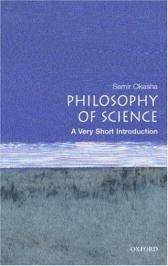
Closure and unresolved issues
The closing chapter on some of the disputes about science ('Scientism', or an over-reliance on 'science' as a model for all of – or the only legitimate kind of – 'knowledge'; Science and Religion; the debate around whether Science is 'value-free') turns out to be an interesting shortcut to opening the reader's mind to significant unsolved problems.
Clarity and analogies
In each case, Okasha gives a very clear, objective overview of the arguments that have persisted (since the 16th Century) about the topics the book discusses using an undoubted ability to find analogies or examples that make otherwise abstract propositions understandable and incredibly concrete. He deftly lays out (which is difficult to do) the reasons why philosophical questions about science are not resolved by science itself, and thus why disputes over these topics continue even today. For instance, all 'empirical' scientific theories ultimately rest on concepts that are more or less 'metaphysical' – which does not mean that choosing among fundamental principles is simply a matter of taste, belief or faith (e.g., Creation Science is clearly not just as good a 'scientific' theory as Evolution), but it does help clarify the nature of the assumptions that serve as the foundations of our scientific theories.
Required knowledge and details
Okasha assumes some scientific and philosophical knowledge on the part of the reader (in fact there is not enough space to dedicate to explanations of specific scientists or theories). However, the book clearly appears to be for scientists rather than philosophers since the author goes into more detail describing the philosophical aspects than the scientific ones. At the same time, the author tries not to take sides in the debates of the field, such as the importance of direct observation, the ideas of Thomas Kuhn (on scientific revolutions), Karl Popper (on the definition of science), etc. The basic scientific issues such as causality, inductive vs. deductive reasoning, and how conflict can arise between science and religion are also covered with extraordinary expertise and attention to detail.
Esotericism and open questions
Philosophy of science, as described in this book, seems to have become a rather esoteric subject, removed from the daily practice of scientists and the everyday use of science. Furthermore, there are several questions that spring to mind but which are not covered in this book: Does the publication and independent verification of results lead to the self-correcting nature of science? Why is the simplest explanation the best? How can scientists who cannot easily perform experiments (e.g. astronomers and sociologists) make verifiable theories?
Invitation to reflection
However there is a reason why. Asking a scholar to write a broad survey of his or her field is an invitation to ponder what is crucial and what is secondary so that a 'very short introduction' is likely to be more influenced by the author's particular choices and preferences than a longer book would be. Moreover, the dialogic nature of philosophy – 'socratically' understood – is a very strong invitation to give space to your way of thinking. Despite this, the author is able to lead by the hand the reader in the world of the philosophy of science in an interesting (and – obviously – short) way.
Shortcomings and probabilities
There is one glaring flaw though: no reference whatever to the frequentist / Bayesian controversy. In addition, probability was mentioned only once in connection to epistemology: rather than saying we know or don't know something for sure, which is bound up with philosophical difficulties, we can assess probabilities of it between 0 and 1 instead.
Importance of modern science
Given the importance of science to modern life, understanding the debates around the core concepts on which modern science rests (and the enormously broad reach – as well as the limits – of science as a way of generating knowledge), is something every educated modern person should do at some level. This little book is an excellent way to get started: it is extremely clear and covers a broad range of topics (although some rather superficially). So, this is definitely not a thorough introduction, but a very well written primer. This book will acquaint you with the core concepts and debates within the philosophy of science, and whet your appetite for further reading (in fact the author provides an interesting list for further reading broken down chapter by chapter).
Conclusion and recommendations
In summary, the author does a commendable effective job of introducing the key task of the philosophy of science (i.e. to analyze the methods of enquiry used in the various sciences) and the main philosophical topics of scientific interest. Shortcomings aside, it is a worthwhile read for everyone interested in the subject.
Domande da interrogazione
- What are the main historical disputes discussed in Okasha's book on the Philosophy of Science?
- How does Okasha address the unresolved issues in the Philosophy of Science?
- What is the author's approach to explaining complex philosophical concepts in the book?
- What knowledge does Okasha assume the reader possesses, and how does this influence the book's content?
- What are some of the shortcomings of Okasha's book as noted in the text?
Okasha's book highlights three historical philosophical disputes: the nature of space debated by Newton and Leibniz, the different schools of taxonomic classification in biology, and the debate among psychologists about the 'modularity' of the human mind.
Okasha explores unresolved issues such as 'Scientism', the relationship between Science and Religion, and whether Science is 'value-free', providing a shortcut to open the reader's mind to significant unsolved problems.
Okasha uses clear, objective overviews and analogies to make abstract propositions understandable, illustrating why philosophical questions about science are not resolved by science itself.
Okasha assumes some scientific and philosophical knowledge, focusing more on philosophical aspects than scientific ones, and covers topics like causality and the conflict between science and religion with expertise.
The book does not address the frequentist/Bayesian controversy and only briefly mentions probability in connection to epistemology, which is seen as a significant omission.



 Accedi a tutti gli appunti
 Tutor AI: studia meglio e in meno tempo


