


Concetti Chiave
- William Shakespeare, born in 1564, greatly influenced literature, inventing 1700 words and modifying the sonnet form with his 154 sonnets that explore complex themes.
- The Elizabethan theatre blended medieval drama's allegory and comedy with classical influences, featuring unique playhouse designs and continuous action.
- The Globe Theatre, constructed in 1599, was pivotal to Shakespeare's career, notable for its large, circular structure and open-air design.
- Shakespeare's plays are structured in five parts: introduction, development, turning point, complication, and resolution, dated through various evidences.
- "Romeo and Juliet" is a tragic love story between members of feuding families, exploring themes of love, fate, and the dichotomy of age and youth.
William Shakespeare
Much of what we know about his life is based on public records. Born in 1564, he attended a grammar school and married Anne Hathaway when he was 18. In 1592 the London theatres were closed and he needed the support of a private patron (earl of Southampton). In 1599 his company built the globe theater and when king James I came to the throne in 1603, it changed its name to "the king's men". He died at 52 in 1623. Some of his friends published 36 of his plays in "the first folio" and the plays were organized into comedies, tragedies, history and roman plays that has shaped our ideas of the shakespeare canon. He invented 1700 words. His sonnets were first published in 1609 and the 154 sonnets are both traditional and experimental: he modified the structure of the sonnet and created new metaphor, providing a complex exploration of gender and sexuality through the fair youth and the dark lady.
▪ the drama: started in the 5th century in greece.
▪ comedy: mocks the vices and follies of society with humorous language, ordinary characters, and every-day situations.
▪ tragedy: features catharsis, strong emotion, a solemn style, elevated language, and aristocratic heroes and villains whose death or destruction end the play.
The Elizabethan theatre
The elizabethan theatre was a combination of the medieval drama and the classical drama. The influences of the medieval drama included: thinking of a play as an animated sermon with allegorical characters and situations, vivid caricature and realistic comedy, a mix of comedy and tragedy, the idea of man's place inside an ordered universe, and the avoidance of aristotle's "3 unities of action, place and time". Elizabethan theatre also drew inspiration from the italian "commedia dell'arte", the works of niccolò machiavelli, the greek theatre, and the latin poet seneca. Regarding the playhouse, they were circular or octagonal. the stage was rectangular and 12 metres wide with no curtains in the front part, and there was a trap door. A tiring house, where the actors changed their clothes, was at the rear of the stage. The stage projected into an uncovered area called the pit, which was surrounded by three tiers of roofed galleries. There was little to no scenery, a limited number of props, and the action was continuous.The globe theatre, erected in london in 1599, was very large and three stories high, with the roof only partially covering the circular structure. The theatre site was rediscovered in 1989, and a new globe theatre was built in 1997.
Shakesperare's plays
His works have been dated combining external evidence (a clear mention of a certain play), internal evidence (when the play itself includes a reference to an event), and stylistic evidence (the changes of shakespeare's style are very noticeable). The structure consists of introduction, development, turning point, complication, and resolution. The stage directions were added by editors and given indirectly, and the progress of the play was connected to the gradual clarification of things.
Romeo and Juliet
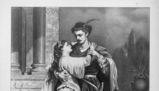
Romeo and Juliet tells the love between a montague and a capulet, characterised by elements of both comedy and tragedy.▪ in act I, Romeo talks with his cousin about his love for Rosaline and, after learning that she will be at a party at the capulets, he decides to attend; there he falls in love with Juliet.
▪ in act II, they declare love to each other and plan to get married by Friar Laurence.
▪ in act III, Mercutio (Romeo's best friend) is killed by Tybalt (Juliet's cousin), so Romeo kills Tybalt; Romeo is banished by the prince to Mantua.
▪ in act IV, to avoid the marriage with Count Paris (organised by her father), Juliet takes a drug that makes her seem dead; Romeo hears about Juliet's death and decides to return to Verona.
▪ in act V, Romeo, believing Juliet to be dead, drinks poison; Juliet, finding Romeo's body beside her, stabs herself; finally, the two families make peace to each other. The main themes are love, fate and death, and age and youth.
Domande da interrogazione
- What are some key aspects of William Shakespeare's life and contributions to literature?
- How did the Elizabethan theatre differ from classical and medieval drama?
- What was the significance of the Globe Theatre in Shakespeare's career?
- How are Shakespeare's plays structured, and what evidence is used to date them?
- What are the main themes and plot points of "Romeo and Juliet"?
William Shakespeare, born in 1564, was a prolific playwright and poet who invented 1700 words and modified the sonnet structure. His works, including 36 plays published in "The First Folio," are categorized into comedies, tragedies, histories, and Roman plays. He explored complex themes of gender and sexuality in his 154 sonnets.
The Elizabethan theatre combined elements of medieval drama, such as allegorical characters and a mix of comedy and tragedy, with classical influences from Greek and Roman works. It avoided Aristotle's "three unities" and featured circular or octagonal playhouses with minimal scenery and continuous action.
The Globe Theatre, built in 1599 by Shakespeare's company, was a large, three-story playhouse that became central to his career. It was partially covered and featured a stage that projected into an open area. The theatre was rediscovered in 1989, and a new Globe Theatre was constructed in 1997.
Shakespeare's plays follow a structure of introduction, development, turning point, complication, and resolution. They are dated using external evidence (mentions of plays), internal evidence (references within plays), and stylistic evidence (changes in Shakespeare's style).
"Romeo and Juliet" explores themes of love, fate, death, and the contrast between age and youth. The plot follows the love story of Romeo and Juliet, members of feuding families, leading to a tragic conclusion where both die, prompting reconciliation between their families.



 Accedi a tutti gli appunti
 Tutor AI: studia meglio e in meno tempo


