


Concetti Chiave
- Hemingway's early life was heavily influenced by outdoor activities and his father's passion for hunting and fishing, which later inspired his fiction.
- After high school, Hemingway worked for the "Kansas City Star" and served as an ambulance driver during World War I, experiences that fueled his literary works.
- Returning to the U.S., Hemingway worked as a foreign correspondent, moved to Paris, and connected with key literary figures, solidifying his writing career.
- Hemingway's prolific period included major works like "The Sun Also Rises" and "A Farewell to Arms," inspired by his love for Spain and war experiences.
- In his later years, despite health issues and a plane crash, Hemingway was awarded the Nobel Prize, but ultimately ended his life due to declining health.
Indice
What were Hemingway's early life and influences?
Hemingway's life is as interesting as his work. He loved hunting, fishing, bullfighting, wartime experiences, and much more of his writings deal with these topics. But his works are generally tragic, often ending in suffering, defeat and death, though with courage and intimate strength. Hemingway was born in Oak Park, Illinois. His father (who eventually committed suicide) was a successful doctor, who loved hunting, fishing and the outdoor life and activities, pursuits which he shared with his son. The happiest part of Ernest's childhood was spent in Upper Michigan, on Lake Walloon, where the family had a summer house. There he fished and hunted, and mixed with the Indians who lived and worked around the lake. These early experiences were later to become one of the sources of his fiction. On finishing High School he took a job on the "Kansas City Star", a local newspaper. In June 1918, a fe months before the end of the World War I , he was sent to the Italian front as an ambulance driver for the American Red Cross. He was wounded and spent six months in the Red Cross hospital in Milan and fell in love with an American nurse, who refused his offer of marriage. The whole experiences became the material for two of his novels.
Career beginnings and personal life
Back in the United States, he got a job as foreign correspondent for the "Toronto Star", and married the first of his four wives. The couple went to Paris, where they met Ezra Pound, Sherwood Anderson, Francis Scott Fitzgerald, Gertrude Stein and other important writers. By the end of 1923 Hemingway had made two trips in Spain and developed a lasting passion for the country. He gained a fair knowledge of the "art" of bullfighting and his first major novel, The Stan also Rises (1926), was not set during the Pamplona fiesta and made Hemingway's reputation as an author.
Hemingway's literary success and war experiences
The next seven years were extremely productive, with two collections of short stories and a second major novel, A Farewell to Arms, which was a best-seller. He was not wealthy from the success of the books and threw himself into an immense variety of pursuits, hobbies, pastime, sports, particularly hunting and fishing. Another of his enduring interests was war. When the Civil War broke out in Spain in 1936, he obtained accreditations as a war correspondent and went to Madrid, where he followed developments closely. The result was For Whom the Bell Tolls (1940), dealing with the experiences of an irregular guerilla group fighting the Fascism behind enemy lines. During World War II he again found a newspaper to accredit him as a war correspondent and flew to London in time to experience the later stages of the Battle of Britain (1940). He also took part in the D-Day landings in Normandy (June 1944) with the Allied armies, and accompanied them on the advance toward Paris, finally taking part in the liberation of the city.
Later years and legacy
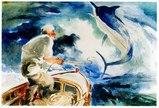
After the war Hemingway lived mainly in Cuba. In 1953 he was badly hurt in Africa in a light plane crash and never fully recovered. In 1954 he was awarded the Nobel Prize for Literature "for his mastery of the art of narrative, most recently demonstrated in The Old Man and the Sea, and for the influence that he has exerted on contemporary style". He spent his last years fighting against physical and mental problems. Realizing that all that lay ahead was the gradual decay of his strength and mental faculties , in 1961 he committed suicide.
Domande da interrogazione
- What early experiences influenced Hemingway's writing?
- How did Hemingway's career as a journalist begin?
- What role did war play in Hemingway's literary career?
- How did Hemingway's personal life impact his literary success?
- What were the circumstances surrounding Hemingway's later years and death?
Hemingway's early life in Upper Michigan, where he engaged in hunting and fishing and interacted with local Indians, significantly influenced his fiction, providing material for his later works.
After high school, Hemingway started his journalism career at the "Kansas City Star" and later worked as a foreign correspondent for the "Toronto Star," which took him to Paris and introduced him to influential writers.
War was a significant theme in Hemingway's work; his experiences as a war correspondent during the Spanish Civil War and World War II inspired novels like "For Whom the Bell Tolls."
Hemingway's personal life, including his marriages and friendships with other writers, influenced his literary success, with his first major novel, "The Sun Also Rises," establishing his reputation.
In his later years, Hemingway struggled with physical and mental health issues following a plane crash in Africa. Despite winning the Nobel Prize in 1954, he faced declining health and ultimately committed suicide in 1961.




 Accedi a tutti gli appunti
 Tutor AI: studia meglio e in meno tempo


