


Concetti Chiave
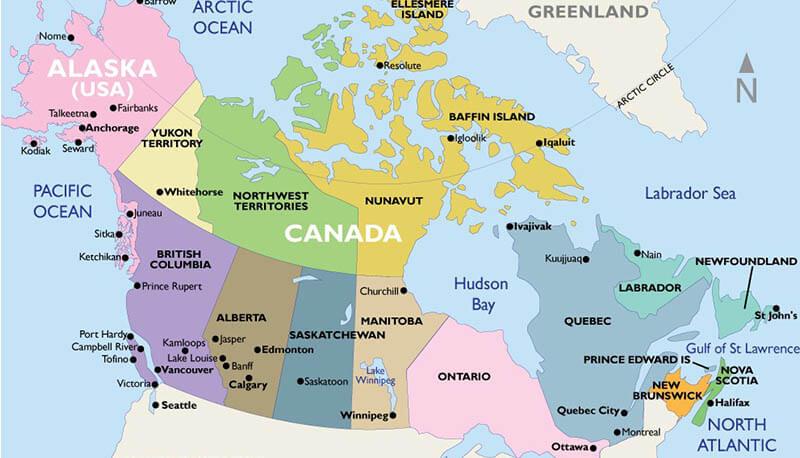
- Canada is the second largest country globally, covering 9,970,610 square kilometers, but has a relatively small population of about 30 million.
- Over half of the Canadian population resides in the southeast, near the Great Lakes and the St. Lawrence River.
- English and French are the official languages, with French predominantly spoken in Quebec.
- Canada is a federation consisting of ten provinces and two territories, and the Head of State is the British monarch, reflecting its colonial history.
- The Canadian dollar is the national currency, and iconic symbols include the maple leaf and the beaver.
Geography and Population of Canada
Canada is the second largest country in the world with area of 9,970,610 square kilometers. Yet its population is only about 30 million, one ninth of that of the Usa. More than half of all Canadians live in the southeast, around the Great Lakes and along the St. Lawrence River.
The languages spoken in Canada are English and French is mainly spoken in Quebec.
Canada is a federation of ten provinces and two territories. The Head of the State is Elizabeth II, the Queen of the United Kingdom, because Canada was a British colony in the past. Today it is part of the Commoneaalth.
Symbols and Currency of Canada
Its currency is the Canadian dollar and its symbols are the maple leaf, which you can see in the flag, and the beaver.
Domande da interrogazione
- What is the population distribution like in Canada?
- What are the official languages of Canada and where is French predominantly spoken?
- What are some of the national symbols and currency of Canada?
More than half of Canada's population resides in the southeast, particularly around the Great Lakes and along the St. Lawrence River, despite the country's vast size.
Canada has two official languages, English and French, with French being primarily spoken in the province of Quebec.
Canada's national symbols include the maple leaf, featured on its flag, and the beaver. The country's currency is the Canadian dollar.





 Accedi a tutti gli appunti
 Tutor AI: studia meglio e in meno tempo


