


Concetti Chiave
- Mathematics: A Very Short Introduction by Timothy Gowers offers a rigorous exploration of mathematical concepts, aimed at stretching readers' intellectual capabilities.
- The book emphasizes the importance of abstract thinking in mathematics to resolve philosophical difficulties, avoiding overhyped topics like chaos theory and Gödel's theorem.
- Gowers presents a captivating introduction to mathematical reasoning, focusing on the philosophical differences between school-level and research-level mathematics.
- Despite its concise 160-page length, the book uses examples, images, and proofs to effectively explain advanced mathematical topics, including numbers and infinity.
- Targeting intelligent students considering a mathematics degree, the book provides a stimulating yet challenging read that unveils the elegance of mathematics.
One of Oxford University Press's series of 'Short Introductions', Mathematics: A Very Short Introduction is a rigorous and challenging description of what mathematics is, and also a marvellously lucid guide and learning experience in various (even advanced) mathematical topics, by one of the greatest pure mathematicians alive (Timothy Gowers is Rouse Ball Professor of Mathematics at the University of Cambridge, and a Fields Medal recipient). Clearly, as belonging to a highly intellectual series, the book is intended to stretch its readers' abilities to the utmost.
Preface and Objectives
The preface sets the stage: "Very little prior knowledge is needed to read this book […] but I do presuppose some interest on the part of the reader rather than trying to drum it up myself. For this reason I have done without anecdotes, cartoons, exclamation marks, jokey chapter titles, or pictures of the Mandelbrot set. 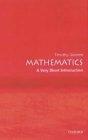 I have also avoided topics such as chaos theory and Gödel's theorem, which have a hold on the public imagination out of proportion to their impact on current mathematical research, and which are in any case well treated in many other books".
Contents and Structure
In 160 pages, there is no space to explain large amounts of mathematics. Nevertheless, Gowers gives a captivating, interesting, and quite personal introduction into some mathematical questions, which get surprisingly close to the "heart of mathematics" in an extraordinarily brief period. This book mainly aims to convey a sense of what mathematical reasoning is like: "if this book can be said to have a message, it is that one should learn to think abstractly, because by doing so many philosophical difficulties simply disappear", claims Gowers in his preface. He speaks clearly and concretely about the role of models and about abstractions, concluding "Once one has learned to think abstractly, it can be exhilarating, a bit like suddenly being able to ride a bicycle without having to worry about keeping one's balance". The declared purpose of this book is to explain - carefully yet not technically - the differences between research-level mathematics and the sort of mathematics learnt at school and such differences are mostly philosophical. However, although it touches on several advanced mathematical topics, Professor Timothy Gowers definitely manages to do a very effective job explaining them as simply as possible: the various chapters are spiked with a great deal of examples, images and proofs, which help one to have a better grasp of the various concepts. The book starts with the explanation of some general aspects of mathematical thought (how abstraction can be used to build mathematical models of existing systems), and then presents the reader with chapters covering more specific topics such as numbers, proofs, limits and infinity, dimension, geometry, estimates and approximates (the readers of this book will surely emerge with a clearer understanding of 'paradoxical-sounding' concepts such as infinity, curved space, and imaginary numbers), and ends with some attention-grabbing frequently asked questions about the mathematical community. He certainly does not give "the only possible correct answers" to such questions, but rather does give convincing, modest, and thoughtful ones.
Conclusions and Recommendations
Even though the book is exquisitely written - and a clearer exposition could not be ever imagined - I hesitate to recommend it to anyone who does not already know a substantial amount of mathematics (otherwise, it would be simply too difficult). Even though mathematics students and professional mathematicians will certainly know all the results offered, they should enjoy the path taken through them. However, the people most likely to benefit from this book are intelligent, well-educated students who are seriously considering doing a mathematics degree. This book is certainly very stimulating to read. It will not help students with school problems, nor will it give a hand with daily life; but it is unquestionably deep, inspiring and unveils the mystery of mathematics and mathematicians: whoever reads it will no doubt enjoy a light, swift, yet intriguing introduction to some of the greatest ideas of mathematics and realise the splendour and elegance of the discipline which the author considers "the key to the universe". Nicola De Nitti
Domande da interrogazione
- What is the primary objective of "Mathematics: A Very Short Introduction" by Timothy Gowers?
- How does Timothy Gowers approach the explanation of advanced mathematical topics in the book?
- Who is the intended audience for "Mathematics: A Very Short Introduction"?
- What topics does the book cover to illustrate the nature of mathematical thought?
- What is the author's stance on the inclusion of popular mathematical topics like chaos theory and Gödel's theorem?
The book aims to convey a sense of what mathematical reasoning is like, encouraging readers to think abstractly, which can resolve many philosophical difficulties, as stated by Gowers in the preface.
Gowers explains advanced mathematical topics simply and effectively, using examples, images, and proofs to help readers grasp various concepts, despite the book's limited length of 160 pages.
The book is best suited for intelligent, well-educated students considering a mathematics degree, as it is challenging and assumes some prior mathematical knowledge.
The book covers topics such as numbers, proofs, limits and infinity, dimension, geometry, estimates, and approximations, providing insights into paradoxical concepts like infinity and imaginary numbers.
Gowers deliberately avoids topics like chaos theory and Gödel's theorem, as they are well-covered in other books and have a disproportionate hold on the public imagination compared to their impact on current mathematical research.




 Accedi a tutti gli appunti
 Tutor AI: studia meglio e in meno tempo


